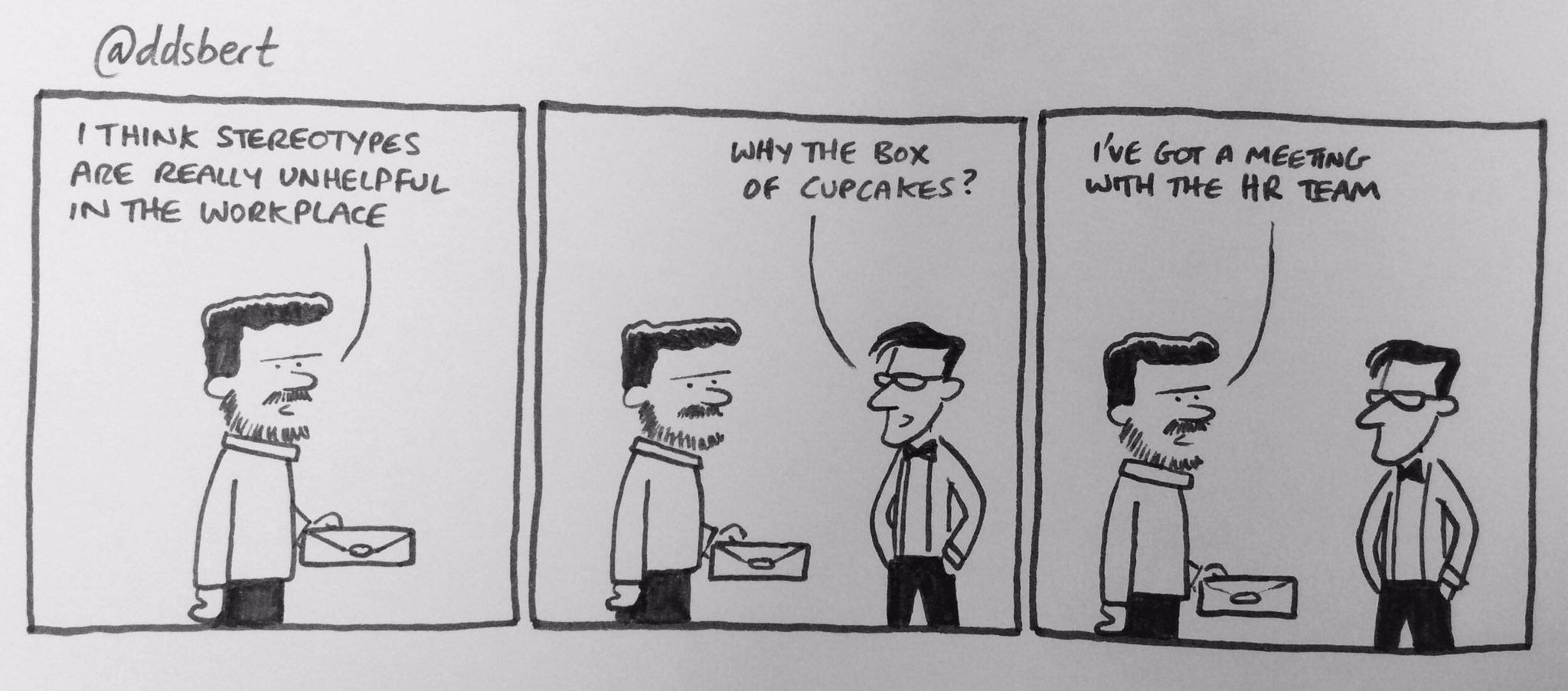
The Thought Terminating Clichés of Work

Content: a reflection on thought terminating clichés in work – with an explanation from Wikipedia up front

I had the delight of learning a new term recently.

A thought-terminating cliché is a commonly used phrase, sometimes passing as folk wisdom, used to end cognitive dissonance(discomfort experienced when one simultaneously holds two or more conflicting cognitions, e.g. ideas, beliefs, values or emotional reactions). Though the phrase in and of itself may be valid in certain contexts, its application as a means of dismissing dissent or justifying fallacious logic is what makes it thought-terminating. It basically tries to stop an argument from proceeding further

The term was popularized by Robert Jay Lifton in his 1961 book Thought Reform and the Psychology of Totalism. Lifton said, “The language of the totalist environment is characterized by the thought-terminating cliché. The most far-reaching and complex of human problems are compressed into brief, highly reductive, definitive-sounding phrases, easily memorized and easily expressed. These become the start and finish of any ideological analysis.”

Wikipedia

That might seem a large chunk to take from Wikipedia but this concept is one of the more interesting I’ve come across in some time. A good example is ‘Brexit means Brexit’. That’s meant to close down a conversation by providing certainty (a certainty that history has rapidly shown doesn’t exist). You hear similar things in the workplace…

  • It is what it is
  • We are where we are
  • It’s common sense
  • We’ve already had this conversation
  • It’s all relative

All of these can be used to suggest the conversation is done – when we know the conversation isn’t done. They sound like complete thoughts, but the reality is that it is a bit more complicated than that. And they are hard to challenge.

My team will testify that I, in particular, hate the statement ‘we are where we are’. That invites the following questions for me

  • Why are we there?
  • Who got us here?
  • Do they know it’s the wrong place?
  • Have we made sure the next place they take us isn’t going to be wrong?
  • How often do they take us to the wrong place?
  • How would we have ended up in a better place?
  • Does everyone understand that ending up in the wrong place is sometimes inevitable, but can’t be a habit?

But the statement is designed to end those conversations due to being a straightforward assertion of position. There is nothing to be done so move on. But moving on is your choice.

So I guess the point of this blog is threefold

i) it’s an interesting term, so I thought I’d share it

ii) Now you know about it you will spot it everywhere. And it is probably about 50% of all tweets…and 90% of political utterances

iii) You can decide to stop closing down other people (if you do so) and can challenge others doing it (if so inclined)

It is what it is.

21 responses

  1. The one that kills me is “Let’s not re-invent the wheel”.

    If Mr Dunlop had taken that approach we would never have had the pneumatic tyre 🙂

    Like

  2. […] a theme taken up by David D’Souza in this piece on the thought terminating clichés we use to avoid challenges to a comforting worldview and close […]

    Like

  3. […] term “thought-terminating cliché” was coined by Robert Jay Lifton in his 1961 book Thought Reform and the Psychology of Totalism, which outlined […]

    Like

  4. […] term “thought-terminating cliché” was coined by Robert Jay Lifton in his 1961 book Thought Reform and the Psychology of Totalism, which outlined […]

    Like

  5. […] term “thought-terminating cliché” was coined by Robert Jay Lifton in his 1961 book Thought Reform and the Psychology of Totalism, which outlined […]

    Like

  6. […] term “thought-terminating cliché” was coined by Robert Jay Lifton in his 1961 book Thought Reform and the Psychology of Totalism, which outlined […]

    Like

  7. […] le terme “cliché qui met fin à la pensée” a été inventé par Robert Jay Lifton dans son livre de 1961 Réforme de la pensée et psychologie du totalismequi […]

    Like

  8. […] ukuto termin „frazes kończący myśli” za pomocą Robert Jay Lifton w swojej książce z 1961 r. Reforma myśli i psychologia totalizmu, […]

    Like

  9. […] The term “thought-terminating cliché” was coined by Robert Jay Lifton in his 1961 book Thought Reform and the Psychology of Totalism, which outlined his theories about the ego formation. “The language of the totalist environment is characterized by the thought-terminating cliché,” writes Lifton. “The most far-reaching and complex of human problems are compressed into brief, highly reductive, definitive-sounding phrases, easily memorized and easily expressed. These become the start and finish of any ideological analysis.” […]

    Like

  10. […] a thought-terminating cliché? “The term ‘thought-terminating cliché’ was coined by Robert Jay Lifton in his 1961 book Thought Reform and the Psychology of Totalism,” explains […]

    Like

  11. […] is a thought-ending cliché? “The The term ‘thought-terminating cliché’ was coined By Robert J Lifton in his 1961 book Thought Reform and the Psychology of TotalismKels McPhillips […]

    Like

  12. […] a thought-terminating cliché? “The term ‘thought-terminating cliché’ was coined by Robert Jay Lifton in his 1961 book Thought Reform and the Psychology of Totalism,” […]

    Like

  13. […] a thought-terminating cliché? “The term ‘thought-terminating cliché’ was coined by Robert Jay Lifton in his 1961 book Thought Reform and the Psychology of Totalism,” […]

    Like

  14. […] a thought-terminating cliché? “The term ‘thought-terminating cliché’ was coined by Robert Jay Lifton in his 1961 book Thought Reform and the Psychology of Totalism,” […]

    Like

  15. […] es un cliché que termina con el pensamiento? «Los se acuñó el término ‘cliché que acaba con el pensamiento’ por Robert Jay Lifton en su libro de 1961 Reforma del pensamiento y la psicología del totalismo«, […]

    Like

  16. […] a thought-terminating cliché? “The term ‘thought-terminating cliché’ was coined by Robert Jay Lifton in his 1961 book Thought Reform and the Psychology of Totalism,” […]

    Like

  17. […] a thought-terminating cliché? “The term ‘thought-terminating cliché’ was coined by Robert Jay Lifton in his 1961 book Thought Reform and the Psychology of Totalism,” […]

    Like

  18. […] a thought-terminating cliché? “The time period ‘thought-terminating cliché’ was coined by Robert Jay Lifton in his 1961 ebook Thought Reform and the Psychology of Totalism,” […]

    Like

  19. […] a thought-terminating cliché? “The time period ‘thought-terminating cliché’ was coined by Robert Jay Lifton in his 1961 e-book Thought Reform and the Psychology of Totalism,” […]

    Like

  20. […] a believed-terminating cliché? “The term ‘thought-terminating cliché’ was coined by Robert Jay Lifton in his 1961 book Thought Reform and the Psychology of Totalism,” […]

    Like

  21. […] When it comes to work/project versions, please see this excellent post. […]

    Like

Leave a comment

About the author

Sophia Bennett is an art historian and freelance writer with a passion for exploring the intersections between nature, symbolism, and artistic expression. With a background in Renaissance and modern art, Sophia enjoys uncovering the hidden meanings behind iconic works and sharing her insights with art lovers of all levels.

Get updates

Spam-free subscription, we guarantee. This is just a friendly ping when new content is out.