
Books and learning

Over the past few weeks I’ve been gradually moving my ‘business books’ into the office. I operate a lending library (and have for a number of years) where anyone can borrow a book if they

i) promise to return it

ii) leave it for me to put it back in its proper place (they are classified by interest/area and then broadly by thematics within that, I’m a geek)

I’ve had a few books go missing over time, including a couple that had sentimental value, so there has been a cost. Also books are heavy – so it means many mornings of carrying a very heavy rucksack to work – my aching back is current cost.

The benefit is that I love being surrounded by books and I love helping others either learn or just enjoy. I also think that books help build relationships – you have shared mental models and stories that can be shorthand for explaining situations. Our comms lead has just returned a book, then followed up with an email full of ideas they would like to test. That is the kind of thing that really brightens my day – and all I have to do to enable that is have books about.

My default position on the often asked ‘Who is responsible for people’s development in work?’ is that as a bare minimum the organisation is responsible for signposting the opportunity and making it accessible. A big pile of books and an email to colleagues to say ‘help yourself’ covers that off.

I don’t read enough these days. Or I read less. And I was pondering on how when you have read past a certain point concepts simply become an amalgam. I don’t know (sometimes) whether what I’m saying is something someone told me or I read or I’ve experienced. Recently I’ve taken on some business areas that I’ve had less direct experience with – and I find myself revisiting techniques and analysis that I can’t remember the source of at all. Frameworks out of thin air.
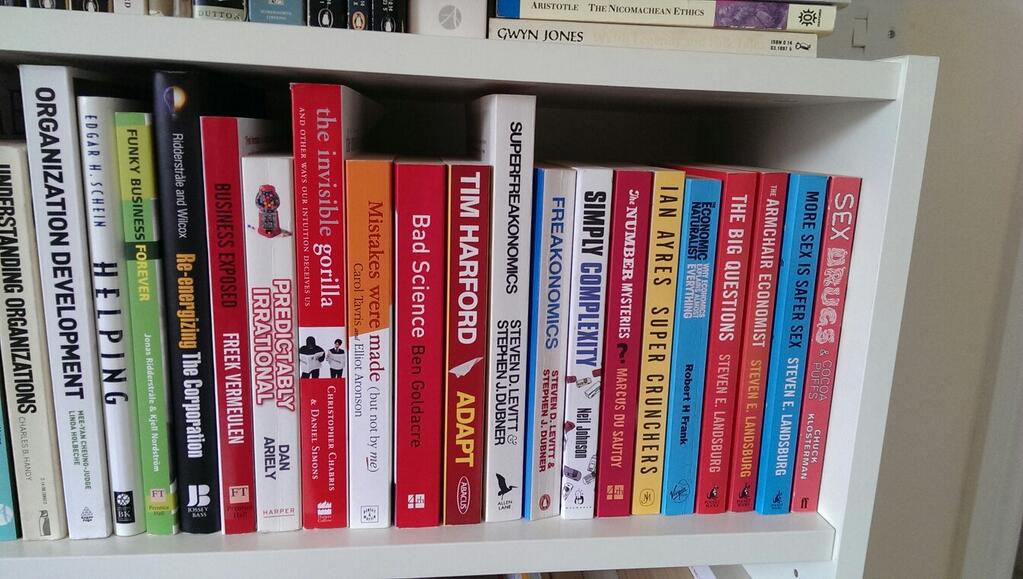
Early in my career I could remember which author gave me which insight. Now my mind is a jumble sale of concepts and I often ponder as to whethermy beliefs are a patchwork quilt from that jumble sale – fragmented and largely unplanned.

Books remain beautiful to me. I’m not fussed about whether you are using a kindle or picking up a hardback – what matters is that you are open to new ideas and concepts and that you never lose that love.

Books are cool.

6 responses

  1. Malcolm Louth Avatar

    Great post David. Interestingly, I don’t (and never have) have a mind which can retain the source of models or principles and concepts – the author of quotes or the architect of ways to do things. I wish I did.

    I have often been in situations where I talk about something – and someone will say ‘oh, so you’re a fan of XYZ then?’ – and it makes me question how the thing ever got in my head.

    A jumble sale is no bad thing.

    Like

    1. Jumble sales have variety and value!

      Like

  2. I read a lot and as a result, I’ve acquired a lot of books. But, like you, I make a point of lending them out as often as possible. It could be a cookery book, something spiritual or a classic book from another century. For those that do read what I’ve given them, I’d like to think it’s changed them a little beyond absorbing more information.

    Julian

    Like

    1. Absorbing information is the platform for change isn’t it? 😉 Also, never try to lend me a cookery book. Your energy will be valued more by another…

      Liked by 1 person

  3. Laura Gawthorpe Avatar
    Laura Gawthorpe

    We found that we were struggling to find time to read within our management team so many of us now read using Audible / Audio Books on journeys to spend the time productively.

    Like

  4. Richard Martin Avatar

    Don’t we all internalise what we have seen, read and heard? We make these fragments our own, in however small a way, incorporating them into our own thinking. A bibliography or a physical library at least acknowledges provenance. I like Margaret Atwood on this point in On Writers and Writing: “I am a writer and a reader, and that’s about it. I’m not a scholar or a literary theoretician, and any such notions that have wandered into this book have got there by the usual writerly methods, which resemble the ways of the jackdaw: we steal the shiny bits, and build them into the structures of our own disorderly nests.”

    Liked by 1 person

Leave a comment

About the author

Sophia Bennett is an art historian and freelance writer with a passion for exploring the intersections between nature, symbolism, and artistic expression. With a background in Renaissance and modern art, Sophia enjoys uncovering the hidden meanings behind iconic works and sharing her insights with art lovers of all levels.

Get updates

Spam-free subscription, we guarantee. This is just a friendly ping when new content is out.